
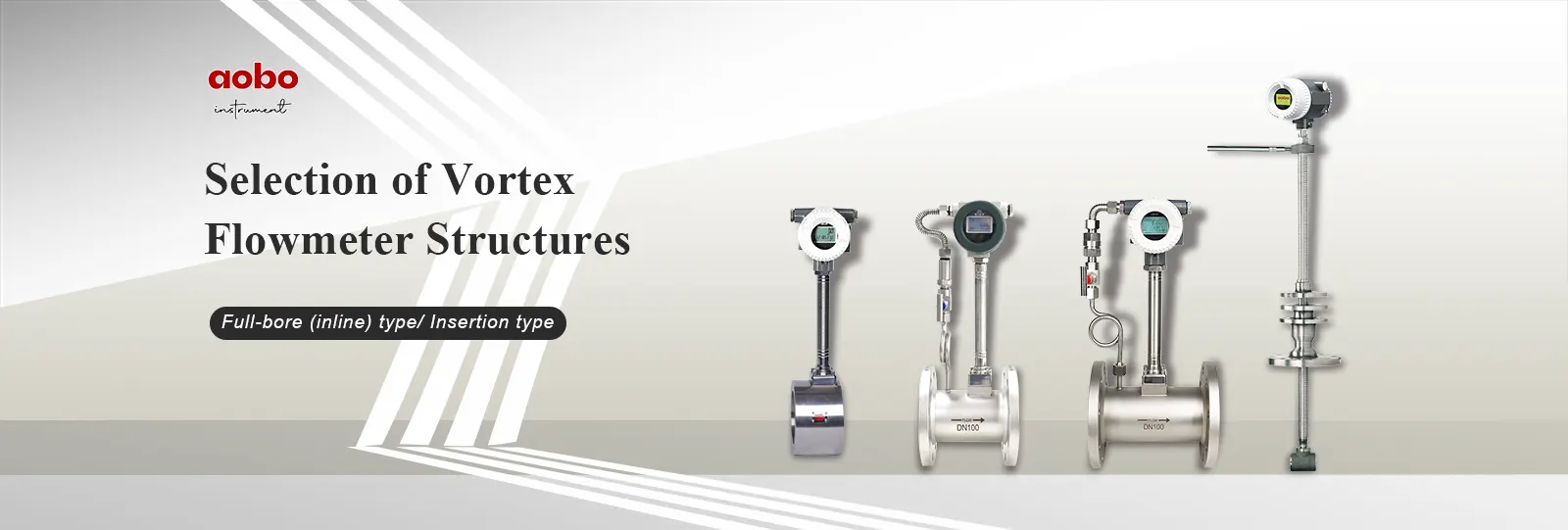
1. Overview
In steam flow measurement, Differential Pressure (DP) Flowmeters and Vortex flowmeters are the two main types in use today. However, when it comes to vortex flowmeters, choosing between inline (full-bore) and insertion-type designs has long been a common dilemma in engineering applications.
The core issue lies in finding a balance between the vortex principle’s dependence on high Reynolds numbers and the practical considerations of cost and installation economics.
So, how should one make the right choice?
2. Principle Analysis
A Vortex Fflowmeter is based on the Kármán vortex street principle, where the vortex shedding frequency is linearly proportional to the fluid’s average velocity:
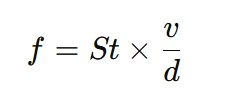
where St is the Strouhal number, v is the average flow velocity, and d is the characteristic width of the bluff body.
The discovery of the vortex phenomenon by Strouhal and the concept of the Reynolds number by Reynolds together laid the foundation for modern vortex flowmeters.
However, the principle comes with a limitation: linearity between the vortex frequency and flow rate only holds when the Reynolds number is above 40,000 (Re ≥ 4×10⁴). At larger pipe diameters, the vortex shedding coefficient decreases, and in some cases, vortex shedding may even be lost entirely.
3. Evolution of Structural Designs
Early vortex flowmeters were typically used in pipe sizes ranging from DN50 to DN300. As industrial applications expanded, the demand for large-diameter measurement of steam, compressed air, and process gases grew rapidly.To overcome the limitations of the vortex coefficient in large diameters, the insertion-type vortex flowmeter was developed.
Although the insertion type provides lower accuracy, it is adequate for most process monitoring applications, while its cost is only about one-third to one-half that of a full-bore design of the same size.
Meanwhile, advances in mechanical machining and electronic detection technology have significantly reduced the difficulty of manufacturing small-diameter full-bore vortex meters, greatly improving signal accuracy. As a result, the applicable range of full-bore vortex flowmeters has expanded to DN8–DN500, while insertion-type designs remain the practical choice for pipe sizes above DN500.
4.Design Considerations for Large-Diameter Applications
It is well known that the meter coefficient (K) of a vortex flowmeter decreases sharply with increasing pipe diameter—approximately proportional to the cube of the diameter (K ∝ D⁻³).
This causes a significant drop in resolution. To mitigate this effect, insertion-type vortex flowmeters were introduced for large-diameter applications, though at the expense of some measurement accuracy.
This raises a question: if insertion types are available, why not use them across all diameters?
First, full-bore vortex flowmeters offer higher measurement accuracy, better repeatability, and superior long-term stability. Their results are more consistent and reliable over time.
Second, from a fluid dynamics standpoint, the pipe frictional resistance can be expressed as:
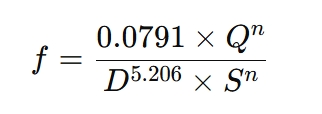
According to the Darcy–Weisbach equation, when the flow coefficient n remains constant, a smaller pipe diameter D leads to higher wall friction, resulting in greater velocity gradients across the cross-section.
Moreover, small-diameter flows naturally exhibit lower Reynolds numbers. Inserting a probe into such a flow further disturbs the velocity field, reducing the Reynolds number even more and deteriorating the vortex shedding behavior. In these conditions, a single-point velocity measurement cannot accurately represent the average flow velocity of the entire cross-section, introducing additional errors.
Finally, when a full-bore structure can be used, it not only ensures accuracy but also provides stable and repeatable measurements. Switching to an insertion-type design in these cases would reduce accuracy and increase installation complexity—offering little benefit in return.
5. Conclusion
- DN8–DN500: Full-bore (inline) type is recommended. It offers high accuracy, excellent long-term stability, and is ideal for applications requiring high precision or trade measurement.
- DN500 and above: Insertion type is recommended. When installed under proper flow conditions, it provides a cost-effective and efficient solution for steam flow monitoring.
- For applications requiring high precision or those exposed to strong vibration, consider wide-range or anti-vibration vortex flowmeters to balance accuracy and practicality.


